<bgsound src="mymusic.mp3" loop="infinite">


Andaman & Nicobar Islands.......

The Andaman & Nicobar Islands is one of the main union territory of India. This union territory of Andaman and Nicobar lands name is often abbreviated to A & N Islands. It is located in the Bay of Bengal.. It comprises two island groups - the Andaman Islands and the Nicobar Islands - which separate the Andaman Sea to the east from the Indian Ocean. The Andaman Islands (10º30'-14ºN; 92-93ºE) are the emerged part of a mountain chain and lie on a ridge, which extends southward from the Irrawaddy delta area of Burma.

The Union Territory of Andaman & Nicobar Islands Stretches over a length of more than 700kms from North to south floating in the clear blue waters of Bay of Bengal, East of the Indian main land and consists of 572 emerald Islands (36 of which are inhabited), islets and rocks.

Mythologically, the name Andaman is presumed to be derived from hanuman, the monkey god, who was known to the malayalis as ‘handuman'. Since pre-historic times, these islands were the home of aboriginal tribes. The tribes of the Andaman group of islands were the great Andamanese, Onges, Jarawas and Sentinalese, all of Negro origin, while the tribes of Nicobars, the Nicobarese and Shompens, both of mongoloid stock.


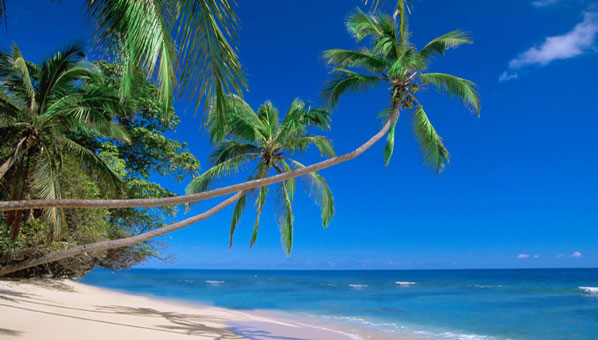
Andaman & Nicobar Islands have also recently been recognized as a world-class eco-tourist destination to discover the under-water treasures of marine life. Andaman & Nicobar Islands has many sandy crystal clear beaches and it’s an eco-friendly tourist destination with all sorts of comforts ranging from five star accommodations to cheap youth hostels.
Andaman & Nicobar Island offers beautiful island vacations and beach tours. Each island in Andaman’s has its own uniqueness and beauty. The beaches in Andaman’s are very clean & crystal clear.

In these islands people of all faiths - Hindus, Muslims, Christians, Sikhs etc., and of all languages like Hindi, Bengali, Malayalam, Tamil, Telugu, Punjabi, Nicobari etc., live together in complete peace and harmony. Inter-religion and inter-regional marriages are common. This amazing racial and cultural mix is correctly described as Mini-India.

Forests are the green extend over gold of the islands. The reserved and protected forests extend over 86% area of the territory and the forest cover is more than 92 %. About 50 % of the forests has been set aside as Tribal Reserves, National Parks and Wildlife Sanctuaries, which are inviolate. Luxuriant mangroves, perhaps the richest in the world, occupy nearly II. 5 % of the territory. More than 150 plant and animals species are endemic in nature. Mahatma Gandhi Marine National Park is rich in corals, varieties of colored fishes, sea turtles etc., besides other marine life. It is a birds paradise - more than 271 varieties of birds inhabit the idyllic landscape, out of which 39 are endemic. Megapode, Swiftlet, Hornbill and Nicobar Pigeon are some of the specialaties of the Andaman & Nicobar Islands.

History of Andaman & Nicobar

A clear history of the Andaman & Nicobar Islands can be had only from a British Survey of these islands conducted in 1777. The Andaman & Nicobar Islands remained the abode of the Negritos and the Mongoloids respectively, who occupied the Islands for centuries. These islands remained secluded from the mainland till the end of the 18th Century when people from the outside world first arrived. The history of these islands could be divided into four broad periods the period of seclusion and piratical disturbances
a) The British regime - a period of foreign intrusion and settlement
b) The Japanese regime
c) and the Post-Independence period
In the Second Century, the Andaman and Nicobar Islands were located in the maps prepared by the great Greek astronomer, mathematician and geographer, Claudius Ptolemaeus, which possibly is the earliest reference to these islands. The early history of Nicobar is not well known although these islands were familiar to traders in ancient times, the islands being situated close to the trade route to the Far East. Though little is known about Portuguese activities in these islands, it is evident that the Portuguese missionaries started preaching Christianity among the islanders. The Nicobarese language also reflects a few Portuguese words.

The British Regime

The history of the British in the Andaman and Nicobar islands began in 1788 when Lord Cornwallis, the then Governor General of India, thought of colonizing the islands and instructed Lt. Archibald Blair and Lt. R.H.Colebrook of the Royal Navy to Survey the islands and submit a report on their suitability for a British Colony. According to the recommendation of these two officers the first British settlement was founded in 1789 on Chatham Island, near Port Cornwallis (Now Port Blair). After the Great Revolt in 1857, the British Government thought of establishing a penal settlement here. In March 1858, the first penal settlement was established, with 200 prisoners, mostly rebels from the Indian Army. Initially the convicts were kept in a jail at Viper island, which is about 15 minutes boat ride from Port Blair. The island had a jail, gallows, Kutcheri, Doctor's residence, etc. Subsequently, this Jail was abandoned and the Cellular Jail at Port Blair was constructed. During the time of successive Superintendents, E.H.Man, General Steward, and Col. Cadell, the number of convicts increased and they were subjected to inhuman tortures at the hands of the British jailors. The foundation of the famous Cellular Jail was laid in 1896. The building was completed in 1906. Many changes, both in policy and practice, took place during Colonel Ferrar's time, which, inter alia, included concession to the convicts, mainland visit, etc.

The Japanese Regime

World War II brought another series of changes in the life of the Andamans. During the War, the Japanese occupied Andamans on March 21, 1942 and kept the region under their effective control till October 8,1945. Initially the Japanese behaved cordially towards the locals, but became harsh and suspicious after instances came to their notice of some locals maintaining contacts with the British. As a result a large number of innocent people were killed. One such place where the massacre occured is Humfreygunj. But one good result of the Japanese occupation was making the Andamans self-sufficient, at least in food production. The naval blockade created an acute food crisis and the Japanese compelled the local people to bring more land under cultivation. They also constructed roads. Netaji Subash Chandra Bose arrived in Port Blair on December 29, 1943 and was given a ceremonial welcome. He hoisted the National Flag at Port Blair on 30th Dec. 1943 for the first time during the British regime in India. On October 8, 1945, the Japanese surrendered to the South East Asia Command at Port Blair. The Government quickly restored normalcy in the area and started rehabilitation work.

The Post Independence Regime

The Andaman and Nicobar Islands together with the rest of India, became Independent on August 15th, 1947. The Bengalis are the major population group which came to the Andamans after Independence. They came as 'settlers' under the Government rehabilitaion scheme, whcih started as early as 1949 and continued till the 1970s. All these groups migrated to the Andamans from different districts of East Pakistan ( now Bangladesh). The Bengalis are primarily distributed in the different villages of North, Middle and South Andamans. The rehabilitated settlers of Great Nicobar are the Ex-servicemen. Ex-servicemen were rehabilated according to the rules of the District Soldier, Sailor, Airmen Board, formerly known as the Ex-servemen Association and the Indian Ex-servicemen League. The first batch of Ex-servicemen came to the island in 1969. Others, from different parts of the mainland followed in 1970,1974,1977,1979 and 1980. These settlers include among others, Punjabis, Marathis, Malyalis and Tamilians. New rules and legislation were enacted and a Chief Commissioner directly nominated by the President of India headed the islands. On November 12, 1982, the post of Chief Commissioner was elevated to the rank of Lt. Governor. The Andaman and Nicobar Islands now send one elected representative to the Lok Sabha.


Andaman & Nicobar Islands

Total Area 8249 sq.kms.
Andaman 6408 sq.kms.
Nicobar 1841 sq.kms.
State Capital Port Blair
Districts Andaman,Nicobar & Mayabunder
Highest Point Saddle Peak (732 mtrs)
Minimum Temperature 23 deg.Celcius
Maximum Temperature 30 deg.Celcius
Rainfall 3000 mms(May to Sept,Nov to Jan)
Relative Humidity 70 % to 90 %
Forest Cover 86 %
Best Season October to April
Languages Spoken Hindi, English, Tamil, Nicobari, Telugu, Malayalam, Bengali


Free Web Hosting